
Black Marlin
Istiompax indica also known as A‘u
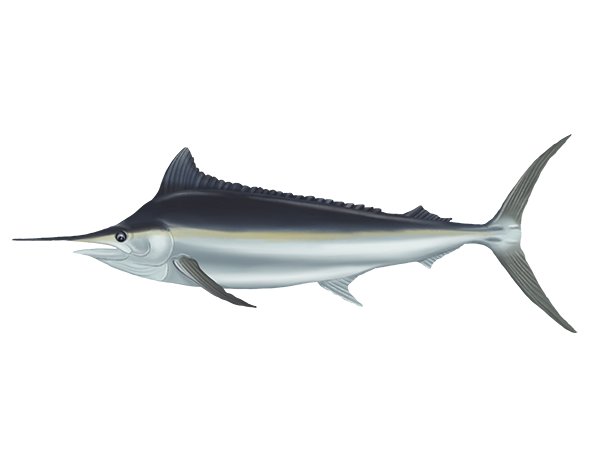
Artwork: © SportfishingReport.com Inc
| Type | Billfish |
|---|---|
| Water | Saltwater |
| Size | 15ft |
| Weight | 1000 lbs |
| Edibility | Poor |
Description
Oceans & Range: Indo-Pacific and Eastern Pacific oceans. Found from Baja California south through Central America and across the Pacific to Australia, Japan, and the Indian Ocean. The premier billfish of the Australian and Pacific Island fisheries. Major sport fisheries exist off Cairns, Australia; Panama; and Ecuador.
Preferred Water Temperature: 70°F–85°F. A warm-water billfish that concentrates along current edges, temperature breaks, and offshore structure in 200–2,000 feet of water.
Size & Weight: The largest marlins in the world — females regularly exceed 1,000 lbs. Average sport catches run 200–500 lbs. World record: 1,560 lbs from Cabo Blanco, Peru. The only billfish known to be unable to fold its pectoral fins flat against its body.
Best Lures: Large skirted trolling lures (12–16 inch) in black-red, purple-black, and dark blue are the standard. Rigged dead bait — whole mackerel, bonito, and large squid — trolled at 7–9 knots. Large surface poppers produce spectacular strikes when fish are tailing. Daisy chains of large skirted lures draw fish to the spread.
Best Baits: Large live or rigged dead skipjack tuna are the premier bait for giant Black Marlin. Whole rigged Spanish mackerel and large bonito produce consistently. Large whole squid rigged on a skirted lure are effective. Rigged dead wahoo produce large fish off Australia.
Habitat
Black marlin inhabit tropical and subtropical oceanic waters, typically in temperatures ranging from 72°F to 86°F. They are highly pelagic but show a strong preference for continental shelf edges, offshore reefs, and seamounts where baitfish concentrate. Unlike other billfish, black marlin often hunt closer to shore near reef drop-offs and island chains, particularly during seasonal migrations. They favor clear blue water with good visibility and are commonly found in the upper 150 feet of the water column, though they can dive considerably deeper when pursuing prey. Black marlin concentrate along current lines, temperature breaks, and upwelling zones where forage species such as tuna, mackerel, and squid gather. They are structure-oriented compared to other marlins, frequently patrolling near underwater pinnacles and continental slopes where baitfish are funneled by currents.
Scientific Classification
| Kingdom | Animalia |
|---|---|
| Phylum | Chordata |
| Class | Actinopterygii |
| Order | Perciformes |
| Family | Istiophoridae |
| Genus | Istiompax |
| Species | Istiompax indica |